



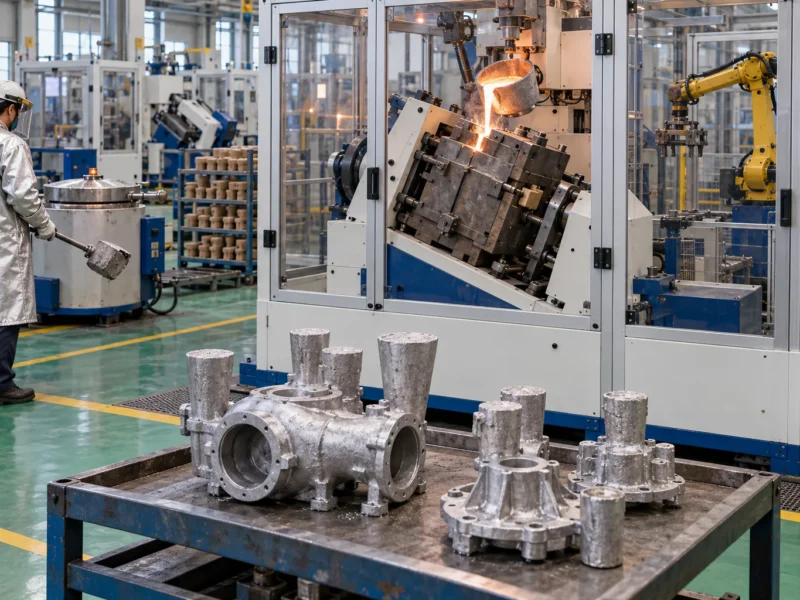
The same aluminum part can often be die cast, gravity cast or sand cast, at very different tooling costs, part prices and properties. Volume, wall thickness and whether the part needs heat treatment usually decide.
How they work
- High pressure die casting: molten metal is injected at high speed and pressure into a steel die. Short cycles, thin walls, the best surface, the highest tooling cost.
- Gravity (permanent mold) casting: metal is poured into a steel or cast iron mold and fills by gravity, often on a tilting machine. Sound castings that can be heat treated, medium tooling cost.
- Sand casting: metal is poured into a sand mold made from a pattern, one mold per casting. Lowest tooling cost, large parts possible, rougher surface.
Comparison
| Die casting | Gravity casting | Sand casting | |
|---|---|---|---|
| Tooling cost | Highest | Medium | Lowest |
| Economic volume | High | Medium | Low to medium |
| Wall thickness | Thin | Medium | Thick |
| Surface finish | Best | Good | Rough |
| Dimensional accuracy | Best | Good | Lower |
| Internal soundness | Can contain gas porosity | Sound | Sound if well fed |
| Heat treatment (T6) | Usually not | Yes | Yes |
| Typical aluminum alloys | A380, ADC12 | A356 | A356 and others |
Typical, simplified comparison.
Rules of thumb
- Thin-walled housings in volume: die casting.
- Structural, pressure-tight or welded parts that need T6: gravity casting.
- Prototypes, low volumes, very large parts: sand casting.
More detail on our gravity and sand casting page and in the A380 vs ADC12 guide.
Frequently asked questions
Can die castings be heat treated?
Conventional die castings are usually not solution treated to T6, because gas trapped in the casting expands at solution temperature and blisters the surface. Artificial aging (T5) and stress relieving at lower temperatures are common. High-vacuum die castings in suitable alloys can be T6 or T7 treated.
Is gravity casting stronger than die casting?
Gravity castings in A356-T6 are usually more ductile and can be welded. Die castings have a fine-grained, strong skin but may contain porosity, so their properties vary more through the section.
Which process is fastest to start?
Sand casting, because patterns are quick and cheap to make.
Have a casting to quote? Tell us the part, the alloy and the annual volume through our inquiry form. We reply by e-mail, and you can send the drawing and 3D file in that thread for a DFM review and quotation.