Other casting routes
Gravity and sand casting when die casting is not the right fit
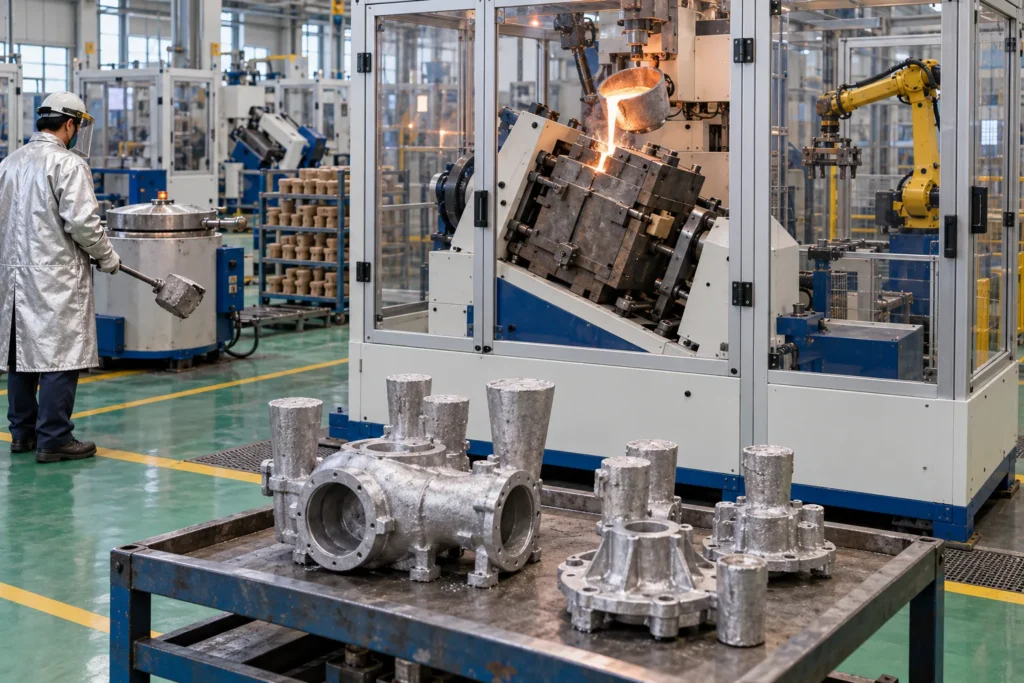
Not every part should be die cast. In gravity casting, also called permanent mold casting, the metal is poured into a steel or cast iron mold and fills under its own weight. Filling is slow and calm, so little gas is trapped and the casting can be solution treated and aged to T6, usually in A356. That makes gravity casting the route for parts that must be welded, heat treated or pressure tight in thicker sections. Sand casting uses a new sand mold for every casting. Pattern cost is low and large or heavy parts are possible; the surface is rougher and tolerances are wider.
Tell us the part size, wall thickness, annual volume and mechanical requirements, and we will propose the route.
Choosing a casting process (typical)
| Die casting | Gravity casting | Sand casting | |
|---|---|---|---|
| Tooling cost | Highest | Medium | Lowest |
| Economic volume | High | Medium | Low |
| Wall thickness | Thin | Medium | Thick |
| Surface and accuracy | Best | Good | Rougher |
| Heat treatment (T6) | Usually not | Yes | Yes |
Gravity and sand casting FAQ
What is the difference between gravity casting and die casting?
Gravity casting fills a steel mold by gravity, slowly, so castings hold little trapped gas and can be heat treated; walls are thicker and cycles longer. Die casting injects metal under high pressure, which gives thinner walls, shorter cycles and a better surface.
When is sand casting the better choice?
For low volumes, very large or heavy parts, or designs that are still changing, because a sand casting pattern costs much less than a steel die.