



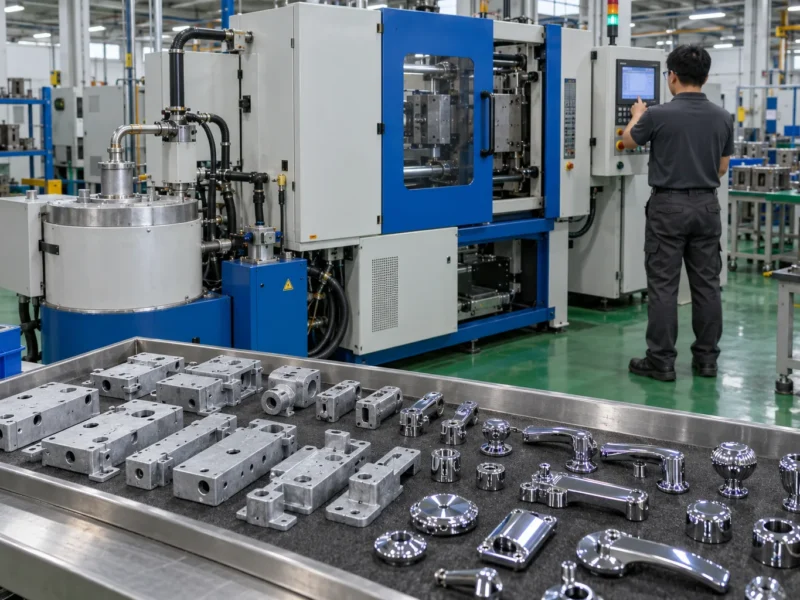
Aluminum and zinc are the two most common die casting metals. Both give complex, near-net-shape parts, but they run on different machines, wear dies at very different rates and suit different finishes. For most parts the choice comes down to size, weight and surface finish.
The short answer
- Aluminum: lighter and larger parts such as housings, heat sinks, brackets and enclosures. Cast on cold chamber machines.
- Zinc: small, precise, detailed parts that are plated or decorative, such as hardware, fittings and small mechanisms. Cast on hot chamber machines, with long die life.
Comparison
| Aluminum (A380 / ADC12) | Zinc (Zamak 3 / 5) | |
|---|---|---|
| Density (typical) | About 2.7 g/cm³ | About 6.6 g/cm³ |
| Casting temperature | High, roughly 650–700 °C | Low, roughly 400–430 °C |
| Machine type | Cold chamber | Hot chamber |
| Cycle time | Longer | Shorter |
| Thin walls and fine detail | Good | Excellent |
| Dimensional precision | Good | Very good |
| Die life | Shorter, limited by heat checking | Several times longer |
| Plating | Possible, less common | Excellent (copper, nickel, chrome) |
| Thermal conductivity | High, good for heat sinks | Lower |
| Creep under sustained load | Low | Noticeable, more above about 50 °C |
| Typical part size | Small to large | Small to medium |
Typical, simplified values; see the alloy standard or data sheet for design figures.
How to decide
- Weight and size: large housings and weight-sensitive parts go to aluminum. Zinc is about 2.5 times as heavy.
- Small parts: zinc can cost less despite the heavier metal, because cycles are short, dies last longer and less machining is needed.
- Finish: bright chrome or nickel plating points to zinc.
- Heat: heat sinks and lamp housings point to aluminum.
- Load and temperature: parts under constant load near heat, such as clamps or brackets close to a motor, should not be zinc.
Alloy data are on our die casting alloys page; design rules for both metals are in the die casting design guidelines.
Frequently asked questions
Is zinc stronger than aluminum?
In typical data, Zamak 5 and A380 have similar tensile strength, and zinc alloys are more ductile. Per unit weight, aluminum is far stronger, and zinc creeps under sustained load.
Why is zinc cheaper for small parts?
Short hot chamber cycles, much longer die life and less machining often outweigh the higher metal weight and price for small parts.
Can the same die cast both aluminum and zinc?
No. Temperatures, shrinkage, gating and machine types differ, so a die is built for one alloy.
Have a casting to quote? Tell us the part, the alloy and the annual volume through our inquiry form. We reply by e-mail, and you can send the drawing and 3D file in that thread for a DFM review and quotation.